
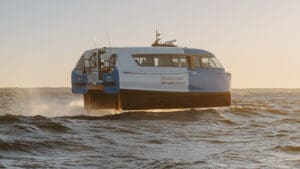
Electric vessel manufacturer Candela has secured €30 million in fresh funding as soaring global fuel prices and growing pressure to decarbonise transport accelerate demand for next-generation maritime solutions.
The funding round, the company’s largest to date, brings total capital raised to €129 million and cements Candela’s position as the best-funded electric vessel manufacturer globally. The round was backed by existing investors including EQT Ventures, SEB Private Equity, KanDela AB and Ocean Zero LLC, alongside a new €8 million investment from the International Finance Corporation (IFC), part of the World Bank Group.
The capital injection will be used to finance a second manufacturing facility in Poland, enabling Candela to scale production of its hydrofoiling P-12 ferries and meet rapidly growing international demand.
The raise comes at a pivotal moment for the maritime sector, as volatile oil markets and rising fuel costs reshape the economics of waterborne transport. Investors are increasingly backing technologies that not only reduce emissions but also offer a clear cost advantage over traditional diesel-powered vessels.
Candela’s P-12 ferry represents a significant technological shift in this direction. Recently named one of TIME magazine’s most important inventions of 2025, it is the world’s first electric hydrofoil ferry operating in scheduled commuter service. The vessel uses a proprietary computer-controlled hydrofoil system that lifts it above the water’s surface, dramatically reducing drag and cutting energy consumption by up to 80 per cent compared with conventional ships.
The result is not only zero-emission travel, but also faster journey times and lower operating costs, a combination that is proving increasingly attractive to city transport authorities and private operators alike.
Founder and chief executive Gustav Hasselskog said the technology effectively creates an entirely new category of vessel, challenging centuries-old maritime design principles. By reducing reliance on fossil fuels and improving efficiency, he argued, the platform allows cities to unlock the full potential of their waterways without being constrained by high fuel costs.
The commercial viability of the model has already been demonstrated in Nordic markets, where the P-12 has been deployed in public transport systems across Stockholm, Gothenburg, Oslo and Trondheim. Early results show significantly reduced travel times and operating costs, alongside strong technical performance.
With serial production now underway and first customer deliveries beginning this month, Candela has built a growing order book of more than 65 vessels. From 2026, the company plans to expand into a range of international markets, including India, where a fleet of ten ferries is expected to cut travel times between Navi Mumbai Airport and the city centre from around two hours to just 35 minutes.
Further deployments are planned in the Maldives, Saudi Arabia’s NEOM project, Thailand and other regions, reflecting what the company describes as a global shift towards efficient, low-emission water transport.
Central to Candela’s growth strategy is its move away from traditional one-off shipbuilding towards scalable, platform-based manufacturing using advanced carbon-fibre construction. This approach allows the company to deliver high-performance vessels at a more competitive price point, addressing one of the key barriers to adoption in the maritime sector.
The involvement of the IFC also signals increasing institutional interest in sustainable transport solutions, particularly in emerging markets where infrastructure constraints and rising fuel costs present acute challenges.
Farid Fezoua, IFC Director for Equity, Funds and Venture Capital, said the investment reflects a broader push to accelerate the adoption of innovative mobility solutions while mobilising private capital and supporting job creation.
Meanwhile, investors highlighted the shifting macroeconomic backdrop as a key driver of the deal. Rising oil prices, exacerbated by geopolitical instability, are making traditional shipping models more expensive to operate, strengthening the case for electric alternatives.
EQT Ventures’ Marnix van der Ploeg noted that hydrofoil technology fundamentally alters cost dynamics, making electric vessels not just environmentally preferable but commercially superior in many cases.
Despite a broader slowdown in climate-tech investment globally, Candela’s successful raise underscores a growing distinction in the sector: technologies that can compete on cost and performance are continuing to attract capital, even as funding for more speculative or subsidy-dependent projects declines.
As global transport systems come under increasing pressure from both economic and environmental factors, Candela’s expansion signals that the maritime sector, long considered slow to innovate, may be entering a period of accelerated transformation.
Read more:
Candela raises €30m as electric ferries gain momentum amid fuel price surge